
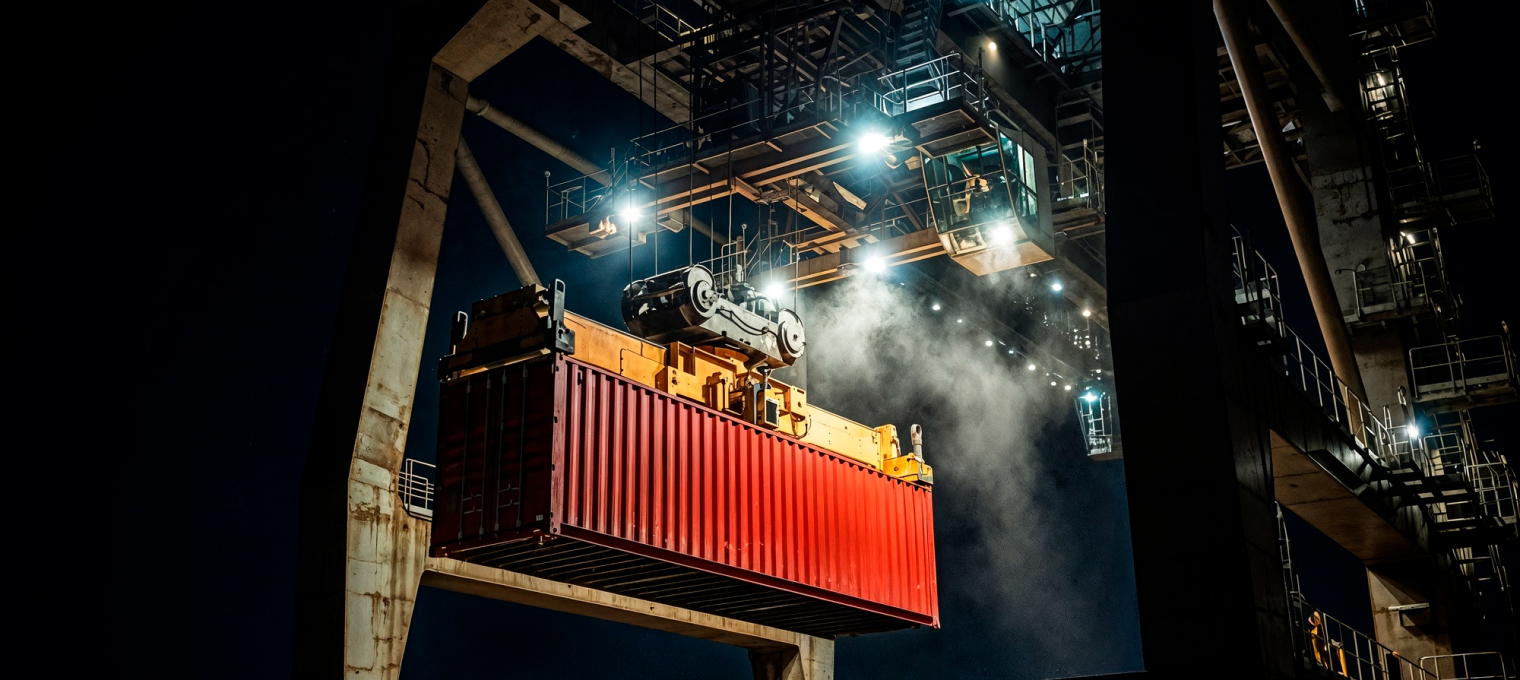

Have you ever seen a big truck carrying a blue or gray metal box? That’s a shipping container. Most people think of it as just a “steel box for cargo.” But there are plenty of interesting facts about shipping containers that rarely get mentioned. From their surprising origin to the secret ID card on every corner.
Let’s explore them one by one. After reading this, your view of the logistics world might change forever.
1. Invented by a Trucking Businessman, Not a Sailor
Many assume containers were invented by sailors or ship engineers. In reality, the brilliant idea came from an American trucking entrepreneur named Malcolm McLean back in the 1950s. He was frustrated because cargo had to be loaded and unloaded repeatedly when moving from truck to ship.
“Why not create a big box that can be lifted whole from truck to ship?” – That was the birth of the modern container.
This fact is fascinating because a “land guy” revolutionized the sea. If you’re interested in efficient land cargo transport, check out Agung Logistics trucking services – we follow McLean’s spirit of efficiency.
2. Every Container Has a Unique “ID Card” – Readable Manually & Digitally
One of the coolest interesting facts about shipping containers is that each container has a unique identification code consisting of 4 letters and 7 numbers. Example: MSKU 1234567. The first letters indicate the owner (like MSC, MAEU, etc.). The last digit is a check digit that can be calculated using a mathematical formula.
You can scan or type that number to track the container’s location anywhere in the world. It’s like a license plate, but global.
At Agung Logistics, we provide real-time container tracking services – no need to do the math yourself. Just give us the container number, and we’ll locate it.
3. Used Containers Can Become Homes, Cafes, Apartments
Who says containers are only for export-import? Abroad, and even in big Indonesian cities, used containers are being transformed into Instagrammable cafes, startup offices, and even houses. Benefits: cheap, strong, and movable.
In the Netherlands, there’s an apartment complex made from 1,000 used containers. In Jakarta, some food trucks use small containers as kitchens.
Our tip: If you have land and need quick space, consider renting or buying used containers from a trusted provider. Agung Logistics has ready-to-use used container stock for various needs.
4. The Average Container Travels Farther Than Earth to the Moon
Imagine this: the container you see at the port might have circled the globe dozens of times. On average, a sea container travels more than 400,000 km during its lifetime. Compare that to the Earth-Moon distance of only about 384,400 km.
Containers go back and forth from Shanghai to Rotterdam, then to New York, then to Surabaya. Every sea journey faces challenges: big waves, extreme temperatures, even storms.
To ensure your container arrives safely on such a long journey, trust Agung Logistics ocean freight services. We have a network and insurance to protect every box.
5. Thousands of Containers Fall into the Ocean Every Year – Some Become “Ghosts”
This fact is a bit spooky, but real: the World Shipping Council reports an average of 1,500–2,000 containers fall into the ocean every year. Some float (dangerous for other ships), some sink. These lost containers are called ghost containers.
Inside, there could be toys, shoes, or car parts. There was even a case of thousands of Nike shoes drifting and washing up on beaches.
Key takeaway: Make sure your containers are secured and transported by a company with high safety standards. Agung Logistics follows international lashing and securing procedures to minimize the risk of lost containers.
6. Container Colors Aren’t Just Blue & Gray – They Have Hidden Meanings
The most common colors are blue and gray. But you’ll also see red, green, yellow, and even white containers. Each color has a meaning:
| Color | Meaning / User |
|---|---|
| Blue | Common for major shipping lines (Maersk, MSC) |
| Gray | Leasing containers |
| Red | Often belongs to specific logistics companies (e.g., Hapag-Lloyd) |
| Green | Reefer (refrigerated) or eco-friendly containers |
| Yellow | Special containers for hazardous materials |
So if you see a green container at the port, it’s not just for style – it likely needs temperature control.
Agung Logistics provides various container types (dry, reefer, open top) with standard color coding for easy identification. Consult your cargo needs on our services page.
7. Container Lifespan 20–30 Years – Then a Second Life
A steel container can “live” for two to three decades with good maintenance. After it’s no longer fit for sea travel (usually due to rust or major dents), it doesn’t just become scrap metal.
They get a second life:
- Turned into workshops
- Portable server rooms
- Modern public toilets
- Even mini swimming pools (yes, really!)
There’s even a container swimming pool in Australia. This proves containers are amazing recyclable products.
“One person’s trash is another person’s home.”
If you need to rent containers for non-shipping purposes or require one-way delivery, contact Agung Logistics. We also help with used container recycling programs.
Conclusion – Your View of Containers Has Now Changed
From a trucking entrepreneur’s idea, to unique ID numbers, to meaningful colors – these interesting facts about shipping containers are too good to miss. The logistics world is not just “take cargo, put in box, ship.” There’s innovation, risk, and a story behind every container.
Use professional container shipping services
Feel free to explore our offerings. We’re ready to help with your logistics, backed by experience and great stories.


