


Indonesia is an archipelagic nation with goods flowing across provinces and islands. The complexity of infrastructure across various regions often creates weak points in the supply chain. Loss of goods during shipping remains common, both due to unmonitored loading and unloading processes and manual recording errors. Inventory inaccuracy also poses a threat to logistics companies, where inventory data often skews, leading to overstocking or shortages related to customer demand.
Furthermore, tracking delays reduce supply chain visibility and slow response to issues. The use of traditional barcodes and paper documents is unable to meet the increasing need for real-time tracking. This situation not only incurs additional operational costs but also erodes the trust of business partners and consumers. In this context, RFID technology presents a cutting-edge solution with the potential to reduce lost goods, improve inventory accuracy, and accelerate tracking at every stage of distribution.
According to the White Paper on Logistics Cost Reduction Cooperation published by the Postal Directorate of the Ministry of Communication and Informatics, inter-hub transport processes in logistics operations contribute approximately 30–35% of total shipping costs. This figure reflects the high contribution of manual processes that have not been efficiently integrated across logistics service providers. Reliance on manual systems and a lack of collaboration between logistics actors leads to wasted resources, time, and costs, thus reinforcing the urgency of digital transformation and the implementation of technologies such as RFID to reduce these inefficiencies.
In the Industry 4.0 era, RFID has emerged as a game-changer for modern logistics. By utilizing radio waves to automatically identify and track goods, RFID replaces traditional barcode methods that are limited to visual line-of-sight. Attaching tags to packages and readers in warehouses, trucks, and distribution centers enables contactless mass reading, improving inventory accuracy by up to 99%, speeding up loading and unloading processes, and providing real-time data for end-to-end visibility. This technology not only cuts operational time and costs but also adds a layer of transparency and control, enabling companies to respond to dynamic market demand with greater agility and efficiency.
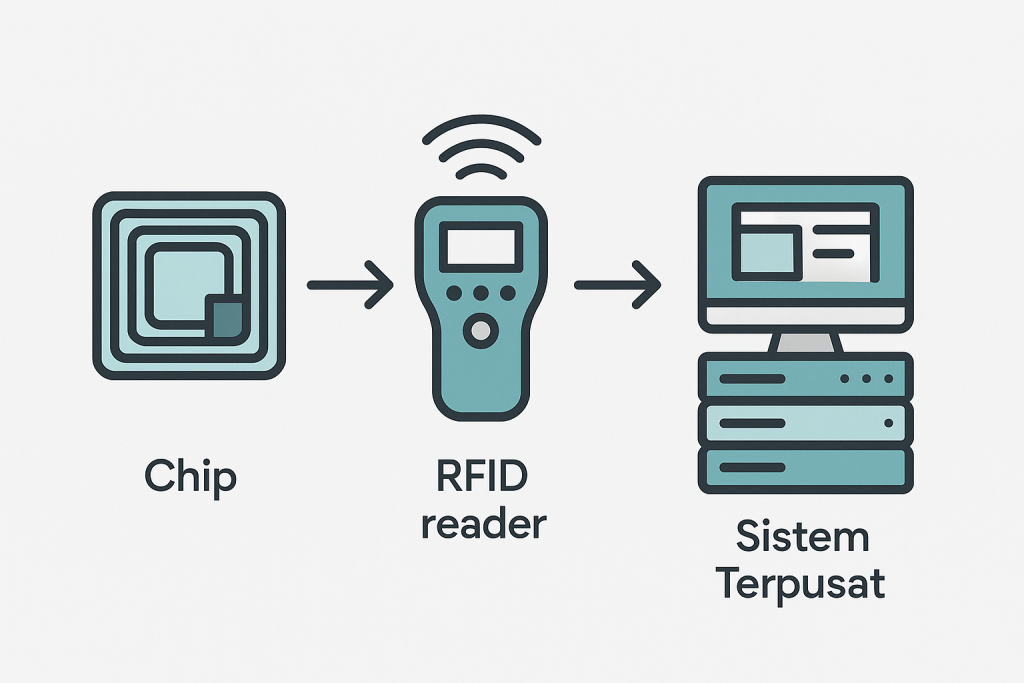
What is RFID and How it Works (Simple)
Radio Frequency Identification, or RFID, is a smart identification technology that uses radio waves to read electronic tags on goods without the need for direct contact. Like a digital ID embedded in each item, RFID tags store unique information that can be scanned en masse in real time, enabling high-speed, end-to-end visibility throughout the entire logistics flow. With up to 99% accuracy and automatic tracking, RFID is a key foundation for creating a smart supply chain.
RFID vs Traditional Barcode
RFID and barcodes are both designed to identify goods, but their working principles are drastically different:
| Aspect | RFID | Traditional Barcode |
|---|---|---|
| Reading Method | Radio waves—no need to “see directly” | Optical beam—must be directed precisely at the barcode |
| Speed | Can scan tens to hundreds of tags at once | One by one, the speed depends on the operator |
| Data Capacity | Stores up to several kilobytes (ID, status, history) | Only store numbers or short text (ID) |
| Environmental Sustainability | Dust, dirt and moisture resistant | Quickly wears out or gets dirty, hard to read if damaged |
| Automation & Real‐Time | Automatic monitoring with instant updates | Only updates when the barcode is scanned manually |
| Implementation Costs | Higher in the beginning (tags + readers), fast ROI achieved | Cheap and widely available, but labor costs |
In short, RFID offers end-to-end visibility and high speed at scale, while traditional barcodes remain efficient for simple, low-volume operations. The choice of technology depends on the need for speed, accuracy, and implementation budget.
Read Also : The Evolution of Automatic Guided Vehicles (AGV) in the Logistics Industry: From Past to Future Solutions
Logistics Problems That RFID Solve
- Inventory Inaccuracies – Mass, real-time tag reading ensures that stock figures in the system always match the physical warehouse conditions, preventing data discrepancies that trigger overstock or stockouts.
- Tracking Delay – With readers spread across critical points (warehouses, depots, fleets), the location of goods is recorded instantly without the need for manual scanning, speeding up response to distribution disruptions.
- Reliance on Manual Processes – Automating the reading of thousands of tags simultaneously reduces operator workload, reduces the risk of human error and streamlines daily operational flows.
- Lack of Supply Chain Transparency – Continuously updated centralized data provides end-to-end visibility, facilitating audits, performance analysis, and collaboration between stakeholders.
Case Study Example: PT GEN-Z
PT GEN-Z, a mid-sized logistics company with a distribution network across Java and Sumatra, faced significant challenges in monitoring goods movement and maintaining inventory accuracy in its main warehouse. Discrepancies between system data and physical conditions—from stockouts of key products to backlogs of slow-moving items—along with the time-consuming and error-prone manual tracking process. This resulted in up to 20% additional costs for handling lost claims and rescheduling deliveries.
In Q4 2023, PT GEN-Z launched an RFID pilot program in one warehouse and its main truck fleet. Readers were installed at entrances, loading and unloading areas, and storage racks, combined with passive tags on each pallet. The centralized system captured real-time data without operator intervention and then integrated it into its ERP for automated notifications and daily reporting.
Results after six months of implementation:
- Operational efficiency increased by 40% thanks to 30% faster loading and unloading processes.
- Inventory accuracy jumped from 85% to 98%, eliminating stockouts and overstocks.
- Tracking time was reduced by 70%, speeding up emergency delivery response.
- Return on investment (ROI) was achieved in 8 months through reduced labor costs and lost claims.
Key Success Factors
- Focused piloting: Test in one warehouse before rolling out to 10 other locations.
- System integration: Connect RFID readers directly to ERP and WMS for automatic notifications.
- Cross-functional training: Engage operations, IT, and management teams in workshops on new processes.
- Monitoring & evaluation: Weekly reports and feedback sessions drive continuous improvement.
Why Choose Agung Logistics?
Agung Logistics has built a reputation for over 10 years as a pioneer in end-to-end digital logistics solutions, combining cutting-edge technologies like RFID, IoT, and integrated platforms to maximize clients’ operational efficiency. Our expertise in optimizing goods flow and inventory, supported by a seasoned technical team, ensures seamless implementation without disrupting business processes. Furthermore, our unparalleled after-sales service—from user training and system performance monitoring to technical support—guarantee operational continuity and continuous improvement. Partnering with Agung Logistics means choosing a provider that is not only leading innovation but also dedicated to ensuring every solution delivers tangible, measurable results for your business.
Conclusion
With Indonesia’s supply chain vulnerable to lost goods, inventory inaccuracies, and slow tracking, RFID technology offers a comprehensive solution—from end-to-end visibility to mass data automation that improves accuracy by up to 99% and speeds up operations by up to 40%. The PT GEN-Z case study demonstrates how RFID implementation can cut costs, reduce human error, and accelerate response times, while Agung Logistics’ over a decade of expertise ensures seamless implementation and consistent after-sales support. It’s time to step into the era of smart supply chains with RFID, where every item is tracked, every process is integrated, and every delivery is on time.
✨Optimize your warehouse with Agung Logistics! Contact our team today.✨
✅ “Need a Quick Solution?”
📞 WhatsApp directly for special offers!
✅ “View Full Services”
🚚 Visit agunglogistics.co.id
✅ “Compare Offers”
💡 Free Quote Request


